We were watching pictures from our Australian trip on the TV yesterday. Whenever A.'s picture came on the screen, the two-year-old would squeal "Amma!". Then, turning to my sister-in-law, she'd translate "my Mommy". (The two-year-old hasn't quite figured out who needs a translation from Tamil and who doesn't it, so she does it for everybody.) My sister-in-law would then say, "no ... it's MY sister". This went on a couple of times.
A few minutes later, A's picture came up on the screen and the poor, confused two-year-old squealed "MY sister".

A bit too British?

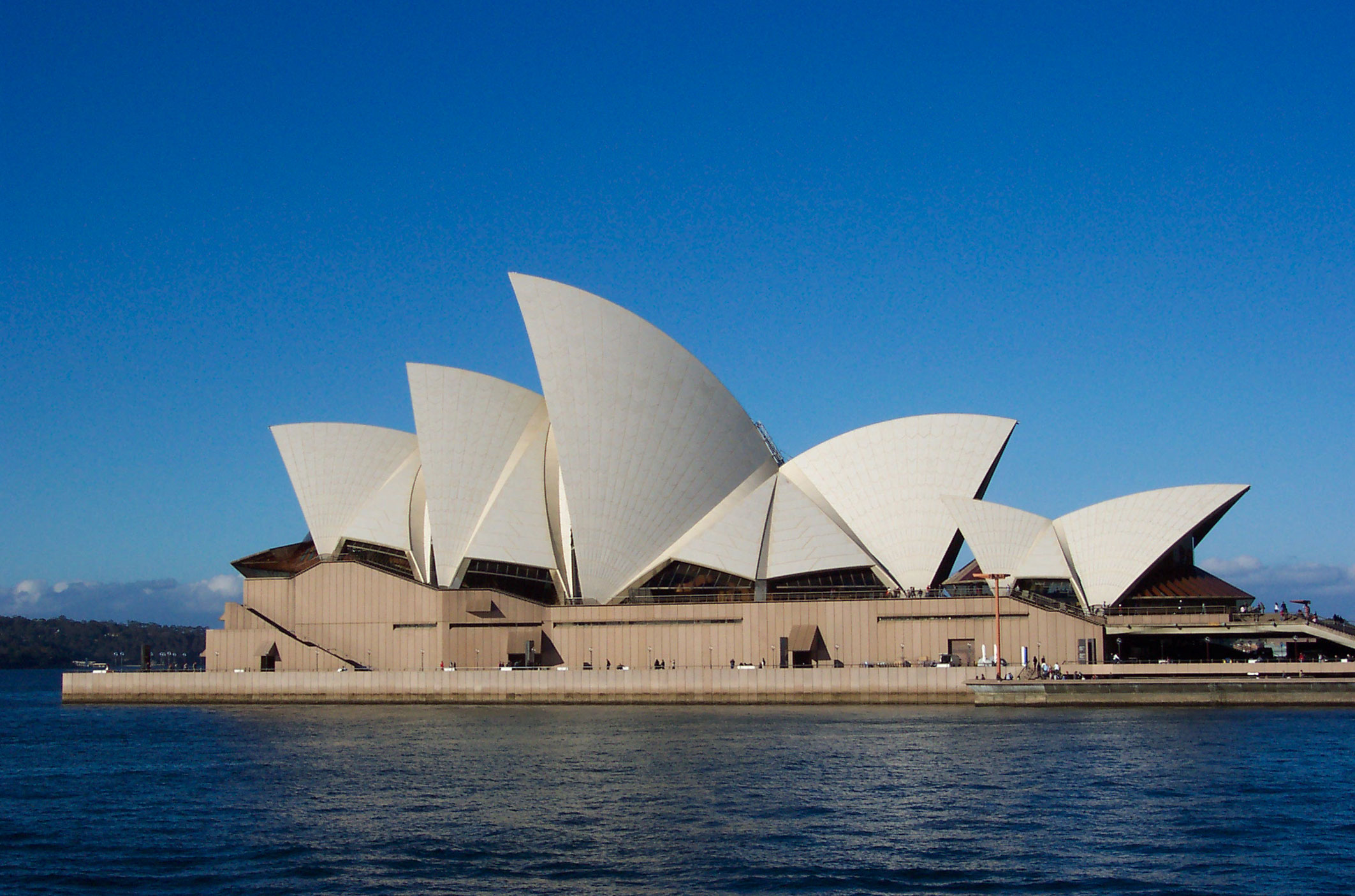
We spent Saturday doing some hectic sight seeing in Sydney. The opera house, I'm sad to say, photographs much better than it really is. The harbor bridge is nice but it doesn't really add to the view. The harbor itself is quite lovely, and traversing it in a ferry is a wonderful experience. Manly beach is quite fun.
 We took a tour of Government House, located in the Royal Botanic Gardens. Australia, to me, is an appealing mixture of American openness tied together with British scale. So, the people are friendly and obliging while the cars are small and the towns are built for walking. It was in the Government house that I saw the other side of the coin.
The Government house is the official house of the Governor of New South Wales, the state that Sydney is the capital of. Now, the Governor is not really elected (that would be the Chief Minister). The Governor is the representative of the Queen (of England). Bloody weird, if you ask me. And to make things weirder, there is very little that is Australian in that house. It's British style through out.
And incidentally, that's where we learned about the new fashion in Australian political life. The Governor doesn't actually live in that house. She has her own house and uses the British monstrosity as her official residence. But she's not the only one. Our hotel was in Kirribilli, a suburb right across the harbor from central Sydney and in Kirribilli is the house of John Howard, the Australian Prime Minister. Apparently, he decided to continue living in Sydney and to travel to Canberra for official functions? How strange is that? Imagine if George W. Bush had decided to stay in Crawford and visit the White House occasionally. That's pretty much what the Australian Prime Minister does.
 Bill Bryson, in his extremely readable travelogue on Australia, remarks that John Howard's decision to continue living in Sydney caused an uproar. Mostly by residents of Canberra who were pissed that they hadn't thought of that first.
Side-by-side
 Friday, A. and I went with a couple of colleagues to Mossman Gorge, part of Daintree National Park. This is part of the Wet Tropics, another World Heritage site (besides the Great Barrier Reef). Queensland really does have an embarrassment of riches -- the tourist brochures make much of the "fact" that this is the only place with two so different World Heritage sites side-by-side. Although, the reef is about 30 miles east of the coast line and the wet tropics are 20 miles west. So, they're actually about 50 miles apart. But ... what is 50 miles considering that we traveled 8000 miles to get there?
You've probably heard the phrase "teeming with life". Believe me, you don't realize what that means until you've been to a tropical rainforest. There are trees with vines growing on them, and parasitic plants growing on the vines. The soil is too water logged? No problem -- the roots stick out of the ground so that they can pull in air.
The great barrier reef is truly great


 Thursday is the day we went to the Great Barrier Reef. All the superlatives you've heard about the reef are true. Gorgeous green water, pristine white sand cays, an endless variety of sea creatures and corals in all sizes, shapes and colors and friendly Australian guides to it all. This is the trip of a lifetime.
The one unfortunate thing about our trip was that we happened to be the first diving group (there were four students to an instructor in the introductory dives). When you have the air tank and weights and are just figuring out to breath through a regulator, being shoved into 30-feet water is scary. So, we didn't end up doing much on the dive. As one of my friends, a diving instructor says, the introductory dives end up pushing it too quick. So, if you want to dive, learn to dive before you come.
But the snorkeling itself was great. Many corals are shallow, and the shallower the corals, the more vibrant the colors. And even in 4-feet waters, the variety of fish and sea critters is incredible. We even saw a blue starfish. There were whales a mile away, but by the time the boat got there, they were gone. So, we didn't see any whales or reef sharks.
The water was a clear, spectacular green. The sea was choppy yesterday, but visibility was still about 30 feet. There was an amazing variety of coral, and with four-feet corals near the cay, you could snorkel for a few minutes over the rocks watching the corals and fish and then simply stand in the sand for a while. Did I mention that this is the trip of a lifetime?
Attending my conference talk
Tuesday afternoon, I took a couple of hours off from the conference. A. and I caught the bus to Tjakupai, an aboriginal cultural center north of Cairns. There was one documentary of how the aboriginals got dispossessed of their land, but the other 2 hours of the show was surprisingly upbeat. There were didgeridoo demonstrations and we got to throw a boomerang and a spear. My boomerang went about 100 yards and came right back to me. I failed to catch it on its return though -- it was about 3 feet above my outstretched hand. Naturally, we bought a boomerang at the gift shop. Will need to try it out at Cambridge park when we get back to Norman.
On the way back, we got talking to a Canadian school teacher. She was in Australia for six weeks. It was nice, she said, to have a job with a long vacation. Even nicer that a couple of friends from college had married Aussies. When I mentioned that I was in Cairns for a conference and that the conference was going on at the time, she said that she hoped that when it came time for my talk, there would be people to listen. Spoken like an old-fashioned school marm.
It's a common misunderstanding that the main reason to attend scientific conferences is to speak -- although I usually speak at the conferences I attend. Instead, it's the networking that takes place at breaks, poster sessions and dinners. The second reason, for me, is to be able to attend talks in fields I do not normally work in -- it's a good way to set up collaborations and steal ideas from other other fields. This conference, I attended talks on precipitation estimation and forecast verification. So, it wouldn't be much of a serves-me-right turnabout if no one turned out to hear me speak.
As it turned out however, my talk (on Wednesday) was quite well attended. It helped that it is part of a session on phased array radars, the hot new thing in weather radar. Secondly, there was no parallel session to siphon off attendees. Thirdly (and probably most important), Wednesday was the day of a conference outing and the banquet, so few people had day trips planned today.
On the way back, we got talking to a Canadian school teacher. She was in Australia for six weeks. It was nice, she said, to have a job with a long vacation. Even nicer that a couple of friends from college had married Aussies. When I mentioned that I was in Cairns for a conference and that the conference was going on at the time, she said that she hoped that when it came time for my talk, there would be people to listen. Spoken like an old-fashioned school marm.
It's a common misunderstanding that the main reason to attend scientific conferences is to speak -- although I usually speak at the conferences I attend. Instead, it's the networking that takes place at breaks, poster sessions and dinners. The second reason, for me, is to be able to attend talks in fields I do not normally work in -- it's a good way to set up collaborations and steal ideas from other other fields. This conference, I attended talks on precipitation estimation and forecast verification. So, it wouldn't be much of a serves-me-right turnabout if no one turned out to hear me speak.
As it turned out however, my talk (on Wednesday) was quite well attended. It helped that it is part of a session on phased array radars, the hot new thing in weather radar. Secondly, there was no parallel session to siphon off attendees. Thirdly (and probably most important), Wednesday was the day of a conference outing and the banquet, so few people had day trips planned today.
Aussie directness

Cairns itself has very little going on. Everything is a drive away. Most touristy things are privately owned, and even the national parks and like have to be reached using tour services ostensibly to reduce the impact of unherded, isolated visitors. This means that there is heavy advertisement and commission-based sales of tours. Truth and moderation are a casualty of the whole setup. It's hard to get information on anything that doesn't involve a $100 tour.
Sunday, we went to a botanical gardens in the north of the city. The gardens has plants from tropical rainforests all over the world. Across from the gardens was a boardwalk that went into the rainforest. We started out at the top of the canopy with light-loving, tall trees. And then you walked into the understory with ferns and the like. And as we walked further and further, the soil got swampier and swampier. The trees and plants changed slowly, finally culminating in paper-bark trees and mangroves. And adjacent to the garden was a 300m hill that overlooked the airport. It took us 40 minutes to climb, but the views from the top of Mt. Whitfield was worth the effort. We could see the Pacific, the rainforest and planes taking off.
We found an elderly couple already at the bus stop to go back. "It's 13 degrees in Adelaide and raining," the lady told us. She was enjoying the heat, but it was still a bit much. "But you don't burn do you," she commented to my wife, "the sun doesn't affect dark skin as much."
Monday afternoon,
 we took off to beaches north of Cairns (Palm Cove, see picture on right). The water was cold (23C) and it was very, very windy but we did get into the water. Don't know how it'll be on Thursday when we go to the Great Barrier Reef. But however cold it is, we're going.
Coming back, we chanced on a shack that advertised itself as the "Outback Opal Mine". We got off the bus and went in. It was not a mine -- it was just a shop with a wall that was made to look like a mine. A scam. But the scam served its purpose because A. bought a few opal earrings to give as gifts. The blues were great and the milky white didn't look as good. "It'll look good on your skin," the saleswoman told my wife, "the white won't look good on a woman from England, but on your skin it'll look quite good." Apparently, Australians are a lot more casual when it comes to mentioning race -- I have a hard time picturing an American making the same comments.
The old fangled way of taking a photograph
Thursday evening (it's Saturday morning for me now: I'm blogging from Sydney airport, but it "feels" like it was last evening), A. and I took advantage of a 5-hour layover in Los Angeles to catch up with R., someone I who I went to elementary school with in Africa. R. brought her cousin along. A young, teenage cousin. We asked the cousin to take a picture of the three of us at the Tapas restaurant.
When I go on long trips, when I'm not sure when/if I'll be able to come across a battery charger or if the voltage/plugpoints will fit, I make sure to turn the LCD screen on the back of my digital camera off because it is a power hog. Besides, I've found that photographs taken at arms length have a greater tendency to shake -- if you squish your camera against your face, that's a
great way to stabilize it. So, I take most photographs the old-fashioned way: by looking through the view finder, not by composing it on a LCD screen.
Anyway, we asked the young girl to take a photograph and I told her to look through the viewfinder. She had no idea. She kept the camera at arms length and said she didn't see anything. I pointed out the eyehole to her, but she still couldn't get the idea that you could look through that peephole to take a picture.
When I go on long trips, when I'm not sure when/if I'll be able to come across a battery charger or if the voltage/plugpoints will fit, I make sure to turn the LCD screen on the back of my digital camera off because it is a power hog. Besides, I've found that photographs taken at arms length have a greater tendency to shake -- if you squish your camera against your face, that's a
great way to stabilize it. So, I take most photographs the old-fashioned way: by looking through the view finder, not by composing it on a LCD screen.
Anyway, we asked the young girl to take a photograph and I told her to look through the viewfinder. She had no idea. She kept the camera at arms length and said she didn't see anything. I pointed out the eyehole to her, but she still couldn't get the idea that you could look through that peephole to take a picture.
Subscribe to:
Posts (Atom)