The threat to innovation on the internet

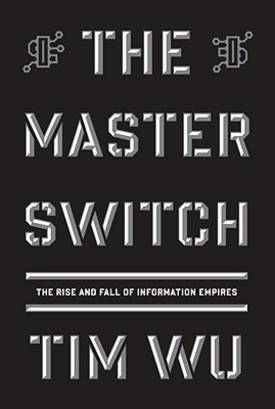
The most incredible anecdote in Tim Wu's "Master Switch" is about how a Bell Labs researcher discovered tape storage (and answering machines) in the 1930s.  The telephone company buried the invention because it feared that people would use telephones less.

The anecdote comes as Tim Wu describes "The Cycle", how information industries go through a cycle of consolidation and decentralization. Decentralized information industries (telegraph, telephone, movies, radio, television) are eventually brought into a low-innovation state by monopolizers. The monopolist quashes all potential threats (internal and external) until some upstart outsider-innovator manages to sneak past, usually with the aid of government regulation that reestablishes a competitive market place.

In the final part of the book, he fingers Apple and AT&T as the would-be monopolists, pointing out that the success of the iPod, for example, owed more to deal-making  than to technical sophistication. He fears for the future of the internet if power gets centralized again in the hands of a cartel  such as Apple + AT&T or Verizon + Comcast.  He is also leery of what would happen if the people whose wires Internet traffic travels over (broadband cable, telephone long distance lines) decide to start imposing tariffs based on the deals they cut with their partners, so that the free flow of information is jeopardized.

The government, he points out, can not muzzle free speech, but private industry sure can. Information cartels, therefore, are dangerous.

The solution? He advocates what he calls a "constitutional solution", where the separation of content-creators, infrastructure providers and device-creators becomes an organizing principle. You've probably heard this referred to as "net neutrality", but Wu brings the concept to life and points out how important it is, to future innovation and innovators, that the open nature of the Internet be maintained.

This is one of those rare books that made me look at a topic that I thought I understood in a new and novel way.  This book is a must-read it if you are interested in technology and in regulatory policy.

The way to be wacky in Oklahoma: be a Buckeye

S2, the six-year-old, is explaining to me that tomorrow is "Wacky Penguin Day" in her class. They are learning about birds, and tomorrow, they are all supposed to come to school dressed as wacky as they can be.

I'm interested because S2 is the polar opposite of whatever wacky means. She likes to gussy things up, to look pretty.  She's the type of person who comes home with a flyer about a "Daddy-Daughter dance" and insists that we sign up, so that she can wear a dress with a bow on it.

"So how are you going to dress for Wacky Penguin Day?"

"You know that Ohio State shirt you got me? I'm going to wear that. That would look wacky, right Appa?"

Sigh.

Culture vs nature

Did you know that color is a cultural concept?

Of course, the color spectrum is quite continuous, and so where you mark off color transitions could be arbitrary. But it isn't because the human eye sees saturation at specific frequencies and it is those colors that receive names and in any case, that's not what I am talking about.

Instead, what I'm talking about is something that British Prime Minister Gladstone first pointed out -- that Homer's epics describe the world purely in black and white. Greek culture at the time did not have words for green or blue -- thus Homer's skies and oceans are dark, not blue or sea-green. Many cultures start out with names of just dark and light, and may add in red.

Colors beyond black, white and red are very much a product of the ability to make artificial dyes.  Until a culture can make any arbitrary color, it doesn't come up with names for any more colors.

In "Through the Language Glass", Guy Deutscher explains it in terms of our language of taste.  The words that we have to describe taste are incredibly crude: sweet, sour, spicy.  A refined palate would probably point out hints of cardamom or mesquite. And that too is the point -- our words for taste are totally circumscribed by their natural sources.  And in a culture that does not make artificial dyes (as opposed to creating reds from cochineal insects, for example), their words for colors are similarly crude.

I picked up the book expecting a quick read of obvious arguments about how German is formal because Germans are formal, but he makes mincemeat of that in the first 20 pages and then delves into truly jaw-dropping stuff.  The book is a must read, not only for the simply amazing anecdotes, but for its sophisticated take on the culture-vs-nature question.

Not that kind of virus!

The 9-year-old and I got into a conversation about microscopes.

Me: "You can use a microscope to see really small things like bacteria and viruses.  Do you know what bacteria and viruses are?"

S1: "Yes, bacteria and viruses are why food gets rotten and computers go bad"

The has-been magazine selects a moldy phenomenon

I hadn't seen or read Time magazine in a long time when I went to the dentist's office yesterday.  

With everyone trying to use up their healthcare flex account (some thing you can thank healthcare lobbying for), the only appointment I got was the last one of the day.   The hygenist was running late (why do dental hygienists have to work in dentists' offices? This one is because of dentists lobbying state legislators).  So, I had to wait.

Anyway, Time magazine.  My choices at the dentist's were:
  1. People magazine
  2. Walking back into the cold, to the car to get my Nook or 
  3. Time magazine
I choice Time.

The first four pages were pharmaceutical advertisements. As were the last four.  What gives? And the articles -- on Sarah Palin, on Palestinian youth growing up behind the wall -- were all very anodyne.  The whole magazine had a musty air about it. Is this because only old people read the dead tree version anymore?

I bring up Time magazine because Mark Zuckerberg, of Facebook, apparently got selected "Time Man of the Year 2010".  By  now, of course, Facebook has ceased to be the new thing on the block.  All the hype that used to be associated with web software is now associated with cool hardware (capacitive touch, anyone?).  

Time, the has-been, selects a phenomenon slightly past its sell-by date.  Typical.

An ode to confiscatory taxes and people who make the best of their capabilities

Reading, "Jet Age", there were a couple of really surprising things that I hadn't heard before:


Boeing started developing the 707 because of confiscatory tax rates.  During WW-II, FDR set taxes at 90% for any profits above what a company was earning prewar (to prevent military contractors from profiteering). This was okay for companies like Douglas which had a civilian business before the war that they converted to military use.  But Boeing had no civilian business, and all of its military profits were therefore "excess profit".  What this meant was the Boeing took its profits and plowed it into R&D because for every $10 it spent on R&D, $9 would have gone to Uncle Sam anyway.  Confiscatory tax rates are responsible for the space age.


Britain's Comet predated the 707.  However, the Comet had a fatal flaw that caused several early Comets to crash.  One of these crashes was after takeoff from Calcutta's Dum Dum airport in the 1950s. The crash was investigated by British and Indian aviation agencies. I read that, and thought: what capability would the Indian aviation agency have had in 1950 and automatically discounted it as mere political correctness on the part of the author. Surely, it's the Brits who would have found any reasons for the crash. As it turned out, the Brits concluded that there was nothing wrong with the plane, but the Indian investigator, a "Shri" Srinivasan (the author mistaking the South Indian version of "Mr." for a first name), insisted on adding in the appendix that the 7th rib of the wing was probably at fault. He came to conclusion by running a simple load test on the wing and noting the stress tolerance happened to be poor at the exact place where the damage had happened. One more illustration of how a good scientist can thrive even in a poor environment.

The elite in America

This morning, NPR ran an interview with an Alabama fisherman who was talking about how the BP oil spill continues to wreak havoc on her livelihood.  Her accent was so thick that I had to focus really carefully  to understand what she was saying.  What's ironic is that I'm now in Alabama.  And no one around me speaks that way.  Accent is simply not a problem amongst the Alabamans I interact with.

What gives? I'm sure NPR didn't cast the fisherman for her impenetrable accent. Instead, this is just one more illustration of the two Americas.  Republican populists rail against the educated, cultured elite; Democratic populists rail against the connected, wealthy elite.  But who are these elite?

I can propose two simple tests: if your accent is bland enough that an Indian immigrant can understand you, you are the liberal elite.  And if you've never decided to forego dental work because you can't afford it, you belong to the conservative elite.  Most of the people I know and interact with on a daily basis fall in the lucky sliver of having both thin accents and good teeth.
How narrow is this sliver? Take the statistic that for the average American, none of his closest four friends finished college.  How many of your friends have never been to college?  Almost all my friends have graduate degrees.  On the other side of the ledger, how many of your friends make less than $20,000 a year? (Students don't count). Half of American families do.  I sure don't know any of them.